Does a Paymaster Really Make Transactions Gas-Free?
Paymasters did not make gas disappear, they just made someone else pay it for you. If in 2026 you transferred on Base via Coinbase Smart Wallet, used a zkSync dapp, or interacted via a Privy embedded wallet, you have almost certainly experienced “gasless” — press a button, the transaction lands, your wallet has no ETH and nothing was deducted. In 2022 this was still a research topic; by 2026 it is a default for consumer apps. But the word “free” hides a real economic model, and understanding it keeps your expectations honest.
What a Paymaster actually is
A Paymaster is a role in ERC-4337 (account abstraction). It is a contract registered with the EntryPoint, declaring “I am willing to pay gas for certain users and certain transactions”. The flow is roughly:
- The user fires a transaction (UserOperation) from a smart account wallet
- The wallet designates a Paymaster to sponsor this transaction
- The Bundler submits the UserOp to the EntryPoint
- The EntryPoint calls Paymaster’s
validatePaymasterUserOp, the Paymaster decides whether to accept - If accepted, EntryPoint deducts gas from the Paymaster’s deposit
- After execution the Paymaster can choose to reclaim the cost from the user (in USDC, in token, or as a full freebie)
The whole process is transparent to the user — they only see “transaction succeeded, no ETH deducted”. But the ETH gas was paid by the Paymaster onchain, and the Paymaster recoups that cost through its business model.
Three mainstream business models
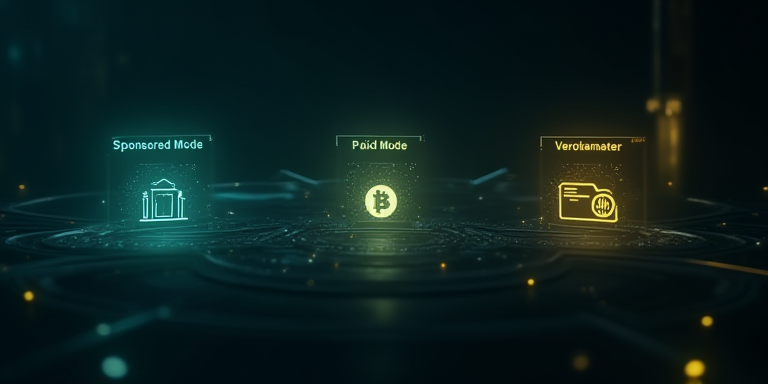
In 2026 the main Paymaster providers are Pimlico, Stackup, Alchemy, Biconomy, ZeroDev. Their sponsorship modes fall into three categories:
Mode 1: project-sponsored
The most common. The dapp project pays the Paymaster service: “any transaction my users make on my contracts gets free gas”. Project teams treat gas as a CAC (customer acquisition cost) line for growth and retention.
This is the real story behind Coinbase Smart Wallet’s free Base transfers — Coinbase tops up the Paymaster so its own users’ small transactions cost nothing. Same pattern for zkSync, Linea and other L2s subsidizing their ecosystems heavily.
User experience: fully free, but only on sponsored contracts. Outside the sponsored scope gas is charged normally.
Mode 2: ERC-20 paid
Users pay gas in USDC, USDT, or another token instead of ETH. The Paymaster collects the user’s token then swaps for ETH on the market to pay onchain gas. This lets a user’s wallet hold only one asset without keeping a dedicated ETH stash.
User experience: still paid, just in USDC not ETH. Typically 5-15% above the raw ETH gas because the Paymaster takes a conversion spread.
Mode 3: verifiable sponsorship
The Paymaster integrates Web2 credentials — Stripe subscription, developer API key — and grants free gas allowance after verifying identity. Common in embedded wallets (Privy, Magic, Web3Auth).
User experience: fully free, but requires some identity binding first.
Real cost: where does Paymaster money come from
Peeling back “free”, in 2026 Paymaster funding roughly splits across four pockets:
| Source | Rough share | Economic essence |
|---|---|---|
| Project marketing budget | ~45% | Acquisition subsidy |
| L2 / chain ecosystem fund | ~30% | Volume subsidy, ecosystem growth |
| ERC-20 paid spread | ~15% | User actually paid, just not in ETH |
| VC / accelerator subsidy | ~10% | Short-term burn, not necessarily sustainable |
The key reading is: the genuinely “free” share (the first two, ~75%) depends on external capital injection, which is fundamentally subsidy. When project acquisition budgets run dry, when an L2 ecosystem subsidy cycle ends, gas comes back. In Q3 2025 when zkSync ended its first ecosystem subsidy wave, users immediately reported “things that were free now charge gas” — that is the receding-tide signal.
Where Paymaster fits well
With the business model in view, you can judge where Paymaster is most valuable:
Strong fit:
- New-user cold start: wallet has no ETH, needs to do its first action. Paymaster eliminates the “first top up ETH” gate. Coinbase Smart Wallet’s takeoff on Base is exactly this mechanism.
- Chain games, subscriptions, light dapps: single-tx gas is far below user value contribution, so the project happily eats it.
- Brand / enterprise onchain onboarding: traditional brands moving into Web3 cannot expose users to “gas” as a concept, sponsorship is required productization.
Weak fit:
- Large DeFi trades: gas is a small percentage of value, free or not does not matter, projects also have no incentive to sponsor.
- Long-running high-frequency arbitrage: providers cap per-user usage to prevent abuse, power users get little sponsorship.
- Any product whose business model depends on “free forever”: subsidies are unsustainable, users trained on free react badly to later charges.
Limits and pitfalls
Before relying on a Paymaster, know its hard edges:
First, Paymaster single-point risk. If the provider goes down or delists your contract, your users suddenly cannot pay gas. In August 2025 a Pimlico RPC outage froze thousands of dapps for two hours. Production best practice is wiring two Paymasters with failover.
Second, anti-sybil limits. To avoid being farmed, providers impose per-user daily caps, per-IP caps, and new-address verification. Regular users rarely hit these, airdrop and automation users hit them often.
Third, congestion can cause failures. If EntryPoint’s gas to validate Paymaster exceeds a preset cap, the Paymaster may reject. Rejection rates rise during chain congestion.
Fourth, non-portability across chains. Each chain needs its own Paymaster deployment. A sponsor on Base does not automatically sponsor the same action on Optimism.
Fifth, regulatory pressure. The act of paying gas for others started attracting regulatory attention in late 2025, treated in some jurisdictions as “providing financial facilitation for non-custodial transactions”. Pimlico and Stackup are working on compliance adapters, but the pressure is still evolving in 2026.
Realistic expectations for ordinary users
Wrap-up advice:
- Paymaster is not the endgame of “no more gas onchain”, it is one implementation of “users do not perceive gas”
- When you see “gasless” marketing, check who the sponsor is and understand whether the money comes from project subsidy or ERC-20 user payment
- Do not treat “free today” as “free forever” — subsidies end
- Paymaster is friendly to newcomers, but power users should accept that gas is still paid eventually
If you want the smoothest Paymaster experience in 2026, the most direct path is installing Coinbase Smart Wallet and using it on Base. Combined with the background in account abstraction and smart account 2025 trend, you can see how “gasless” went from research topic to consumer default — while staying clear on where its edges sit.