What Does Coinbase Smart Wallet Using Passkeys Actually Mean?
Coinbase pushed Smart Wallet to mainnet in mid-2024, and by 2026 it has become the default on-ramp for new US users meeting onchain wallets for the first time. The most counterintuitive part is the open: there is no seed phrase, no private key import, just a one-step prompt asking your phone or laptop to do a Face ID or fingerprint scan. After that you own an onchain account that works across devices and dapps. Two ideas are quietly fused under the hood: Passkey (a WebAuthn device key) and smart contract wallet (account abstraction). Let us pull them apart, then look at what Coinbase actually solved by stitching them together.
What a Passkey really is in the browser
Passkey did not start at Coinbase. It is the WebAuthn standard finalized by FIDO and W3C in 2022. In plain terms it lets your device (phone, laptop, security key) act as a hardware signer. When you register on any Passkey-enabled site the device generates a keypair locally: the private key stays in a hardware enclave (iPhone Secure Enclave, Android StrongBox, Windows TPM, Apple Silicon T2), the public key goes to the site.
On login the site sends a challenge, you do a biometric or PIN, the device signs with the private key and returns the signature. The private key never leaves the device, and the site never sees it, which means even if the site is dumped or you fall for a phishing page the private key does not leak. That is the structural advantage of Passkey over passwords, SMS codes, or TOTP apps.
Apple, Google, and Microsoft baked Passkey into their OS-level password managers in 2023. iCloud Keychain, Google Password Manager, and Windows Hello sync Passkeys across devices with end-to-end encryption. That is why a Passkey created on an iPhone unlocks instantly on a Mac with Touch ID. Coinbase Smart Wallet leans on that sync mesh hard, because it means users moving to a new device do nothing extra.
How a smart contract wallet bolts to a Passkey
Classic Ethereum accounts (EOAs) only accept secp256k1 signatures, while Passkey signs with P-256 (also called secp256r1). The two curves are mathematically incompatible, which is why you cannot just pipe Passkeys into MetaMask. Coinbase Smart Wallet sidesteps this: the wallet itself is a smart contract, and the contract declares “P-256 signatures are valid authorizations”.
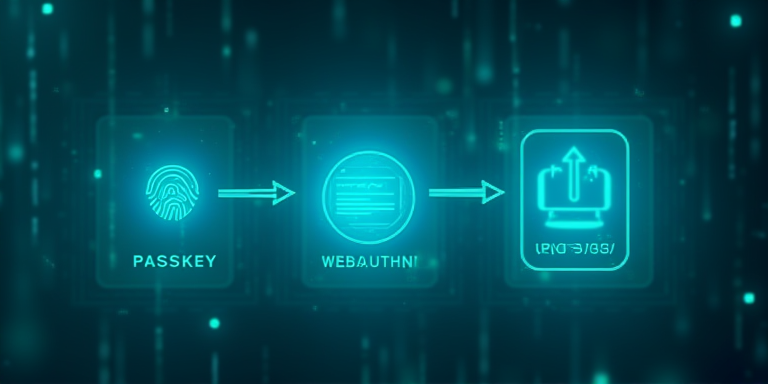
Concretely the flow is:
- User opens Smart Wallet the first time, the browser calls WebAuthn API and generates a Passkey
- Coinbase uses an ERC-4337 factory contract to deploy a smart account address that maps to that public key
- Every later action (transfer, signing, dapp interaction) is signed locally by the Passkey, the signature is sent to a Bundler, the bundler calls the contract’s
validateUserOp, the embedded P-256 verifier checks it, and the operation executes
There was a real bottleneck here: verifying P-256 onchain used to cost far more than secp256k1. Native secp256k1 has the ecrecover precompile (a few thousand gas), but a pure-Solidity P-256 verifier ran 300k to 1M gas, which made it unaffordable. RIP-7212 is the Rollup Improvement Proposal that fixed this by adding a P-256 precompile. Base, Optimism, and Arbitrum shipped RIP-7212 across late 2024 and verification dropped to 3450 gas. Only after that did Passkey wallets become production-grade on L2.
What Coinbase actually shipped by combining them
Smart Wallet is not a lone product. It is the integration point for a full stack Coinbase has been building. A side-by-side with classic EOA wallets makes the gap obvious:
| Dimension | EOA wallet (MetaMask etc.) | Coinbase Smart Wallet |
|---|---|---|
| Onboarding | 12 or 24 word seed phrase | One biometric scan, no seed |
| Private key location | Encrypted browser storage (readable by malicious extensions) | Device secure enclave (never exported) |
| Cross-device | Re-import the seed | Auto-sync via iCloud or Google |
| Gas | Must hold ETH | Paymaster sponsored or paid in USDC |
| Social recovery | None, lose key lose everything | Multi-sig or recovery module |
| Batch tx | No, approve and swap need two tx | Atomic bundle, one signature |
| Default chain | Ethereum mainnet | Base mainnet (other OP Stack chains add easily) |
In 2026 this bundle won Coinbase a user segment older wallets struggled to reach: people already used to unlocking banking apps with Touch ID but scared off by the words “seed phrase”. Smart Wallet monthly active accounts on Base went from 800k at the end of 2024 to 9.4M in Q1 2026, mostly driven by the in-app “onchain wallet” entry inside the main Coinbase app, which reused those users’ existing Passkeys.
How does it relate to EIP-7702
A common follow-up: EIP-7702 lets EOAs temporarily borrow smart contract abilities, so do we still need a native smart wallet like Coinbase’s?
The answer is they target different people.
- EIP-7702 is for existing EOA holders. You keep your address, you just delegate to a contract template and gain Paymaster, batching, and Session Keys.
- Smart Wallet is for users who never owned an EOA and never need one. They are smart-account-native from day one.
After Pectra shipped, the two paths coexist comfortably because their target users barely overlap. Coinbase’s own wallet SDK in 2026 even offers 7702 delegation to legacy MetaMask users, which is the same team hedging both sides.
Risks and limits
Now the honest part. Passkey wallets in 2026 still carry edges a user must see clearly.
First, cloud sync cuts both ways. Cross-device Passkey sync rides on iCloud Keychain, Google Password Manager, and similar large-account systems. If your Apple ID or Google account is taken over, the attacker can in principle restore your Passkey on a new device. This matters most for large balances, which is why Smart Wallet’s UI nudges high-balance users to add multi-sig recovery contacts.
Second, cross-chain still breaks. Smart Wallet is smoothest on Base and other OP Stack chains. Once you leave the OP Stack family (Arbitrum One, Polygon zkEVM, etc.), you depend on whether the chain deployed RIP-7212. Without the P-256 precompile you either pay outsized verification gas or bridge back to Base, which fractures the “all-chain” promise.
Third, contract upgrade risk. Smart Wallet is, at the end of the day, a contract. Contracts can break from upgrade bugs, key management flaws, or bundler outages. Coinbase published audits and put a time-lock on upgrades, but users should mentally label the asset: “your wallet is code, code can fail”. EOA wallets are conceptually simpler because as long as the seed survives and the chain holds, the account holds.
Fourth, compliance coupling. Smart Wallet in the US restricts interactions with some high-risk addresses by policy. That is regulatory reality, but it does mean this product is not a fully neutral onchain account. Users who need a censorship-resistant account should pick a wallet without those filters, see the selection notes in the wallet primer.
With those edges in view, Passkey-based wallets are a path ordinary users should seriously consider in 2026. They erase about 90% of the UX pain, and the remaining 10% becomes manageable once you understand where the boundaries sit.