Is Liquid Cooling Really a Must-Have for Mining in 2026? The Economics of Heat and Lifespan
Open any May 2026 trade-show coverage and the headline is identical — “liquid cooling is the new standard for new mining farms.” Bitmain, MicroBT, and Canaan have shifted entire flagship lines to liquid form factors. It sounds like a sweeping engineering revolution. But when an S23 Hydro costs 3,800 USD more than an air-cooled S21 Pro, an operator has to ask: how long does it take that premium to be repaid in power savings, density, and longevity? Is liquid cooling a real requirement or amplified marketing? Below we separate the engineering thread from the economics thread to land on a non-hyped answer.
Where liquid cooling outperforms air
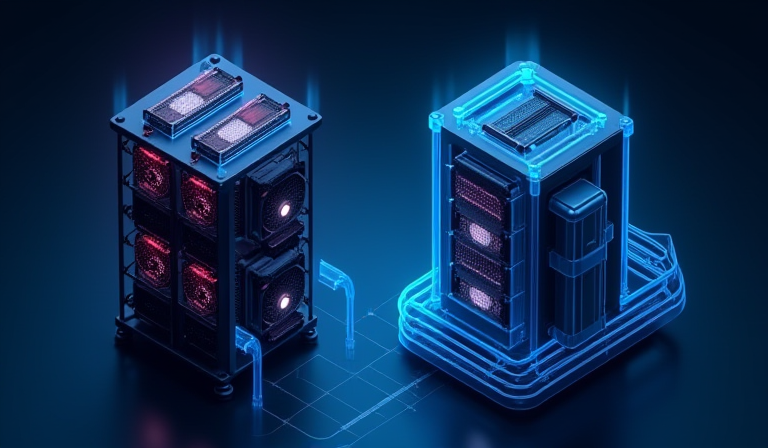
Engineering-wise, liquid cooling has four clear advantages over air:
- Thermal efficiency: water has 3,400 times the volumetric heat capacity of air, so the same volume of water removes vastly more heat. A 5,800 W rig’s waste heat needs only a few liters of recirculating coolant.
- Rack density: air-cooled farms typically deploy 3-5 kW per square meter, while liquid-cooled facilities reach 15-30 kW — a five to sixfold density gain.
- Ambient noise: liquid cooling removes most axial fans, dropping per-machine noise from 75 dB to 35 dB. This matters for urban-edge facilities and any site near residential zoning.
- Lifespan extension: chip temperatures drop from 80-90 °C on air to 50-65 °C on liquid, and Bitmain’s lab data suggests expected lifespan extends from 3 years to 5 years.
Those four together make liquid cooling engineering-superior. Whether the engineering edge becomes an economic edge depends on your specific farm.
What it takes to recoup the 3,800 USD gap
A two-rig comparison:
| Dimension | S23 Hydro (liquid) | S21 Pro (air) |
|---|---|---|
| Hashrate | 580 TH/s | 234 TH/s |
| Power | 5,800 W | 3,531 W |
| Efficiency | 10 J/TH | 15.1 J/TH |
| Sticker price | 11,800 USD | 8,000 USD |
| Price per TH | 20.34 USD | 34.19 USD |
| Daily revenue per TH | 0.0332 USD | 0.0332 USD |
At first glance, the S23 Hydro costs only 60% per TH of the S21 Pro. Normalized for hashrate, liquid is already cheaper — the 3,800 USD difference is an absolute number, not a unit-cost story. To match one S23 Hydro you need 2.48 S21 Pros, total cost 19,840 USD. The premium framing simply does not survive normalization.
Liquid still requires CDU, cold plates, and dry coolers. Amortizing that infrastructure (about 1,500 USD per rig) makes the effective S23 Hydro cost 13,300 USD, or 22.93 USD per TH — still 33% cheaper than air per TH.
Real numbers on power savings
Going from 15.1 to 10 J/TH means 33% less power for the same hashrate. At 580 TH/s of capacity:
- Single S23 Hydro: 5,800 W
- Equivalent S21 Pro setup: 2.48 × 3,531 = 8,757 W
- Hourly savings: 2,957 W
- Daily savings: 71 kWh
- Annual savings: 25,915 kWh
- Power savings at 0.09 USD/kWh: 2,332 USD per year
In other words, on power alone, liquid cooling saves 2,332 USD a year compared to matching air-cooled capacity. Three years stacks to 7,000 USD, five years to 11,660 USD. For any operation past 1 MW, the economic case for liquid is concrete.
The deployment difficulty marketing skips
Liquid looks unbeatable on paper, but the deployment barrier is high — and quietly omitted in the marketing.
- Coolant distribution units: 15,000 USD each, requiring custom engineering
- Cold plates and quick-disconnects: 200 USD per rig, professional installation only
- Dry coolers or cooling towers: about 40,000 USD per 50 rigs
- Electrical retrofits: higher power density demands new switchgear and cable runs
- Coolant quality management: deionized water, corrosion inhibitors, annual lab tests, ongoing opex
- Leak risk: water in an electrical panel is catastrophic; leak detection and emergency shutoff systems are required
Combine the capex and opex and the realistic entry bar for liquid is around 500 kW of capacity. Below that, infrastructure per rig dilutes the power savings. A single-rig home miner buying liquid hardware is wearing a tuxedo to ride a bicycle — hardware capability without the supporting facility.
Who should and who should not
Stacking engineering, economics, and ops together, here is a tiered conclusion:
- Single-rig home miners: do not touch liquid; air-cooled S21 Pro or S21+ is fine
- Small farms (10-50 rigs): experiment with one liquid rack but do not retrofit everything
- Mid-size farms (50-500 rigs): liquid is the preferred choice; power savings repay capex within three years
- Large farms (500+): liquid is the default — anything else falls behind industry density norms
- Greenfield builds: design liquid in from day one to avoid expensive retrofits later
This tiering mirrors the scale-effect argument from the ASIC vs GPU mining comparison — mining outcomes are increasingly decided by scale and efficiency, not raw hardware choice.
Cooling paths beyond liquid
Two other 2026 cooling paths deserve mention:
- Immersion cooling: submerging rigs in mineral oil or fluorinated fluid, exceeding single-phase liquid in efficiency. GRC and Submer are the leading vendors, focused on large-scale farms.
- Heat reuse commercialization: some Nordic operators sell mining waste heat to district heating networks, adding hundreds of dollars per rig per year. Pilot deployments are also appearing in new Chinese sites.
Neither matters for home mining, but both should be on the radar for mid-to-large operations. They complement the “home mining is harder than ever” finding in is home mining still profitable in 2026 — professional farms are finding fresh upside through cooling innovation even as home operators retreat.
So, must-have or marketing
Back to the title question. After running the full set, “liquid cooling is mandatory” is a scale-gated truth. For mid-and-larger farms it really is the 2026 default; for home and small operators it is marketing overload. Personal decision-making collapses to two questions:
- Is your capacity 500 kW or above? If yes, evaluate liquid seriously
- Can your cash flow absorb a 7-15% one-time infrastructure premium? If not, the technology is not for you
Liquid cooling’s role in 2026 is genuine, but it is solving density, efficiency, and lifespan for professional operators, not retail home miners. See that layer clearly before committing to the premium. The next piece returns to is home mining still profitable in 2026 for a complete retrospective.