What Is Ethereum's Interop Layer and Why People Say It Makes L2s Feel Like One Chain
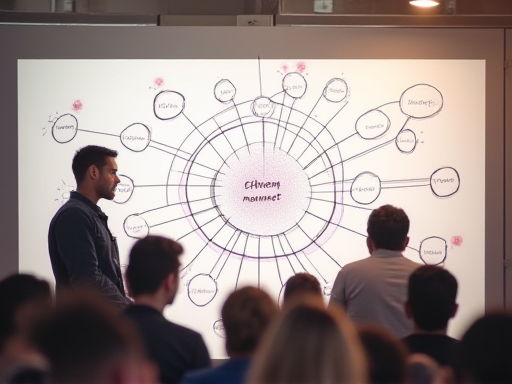
The first time I heard the phrase Interop Layer in person was at EthDenver 2026. An Ethereum Foundation researcher stood at a whiteboard and drew one circle in the middle labeled “mainnet,” surrounded by twenty smaller circles labeled Arbitrum, Optimism, Base, INK, Soneium, UniChain, Scroll, Linea, and more. Then he connected every circle with thin lines and wrote one sentence next to the diagram: “We want these twenty circles to feel like one circle from the user’s perspective again.”
That was the moment I realized the next big step for Ethereum after Pectra is not a faster L2. It is making L2s stop behaving like twenty separate countries.
One sentence summary
The Interop Layer is not a new chain and not yet another bridge protocol. It is a set of standards added at Ethereum’s protocol level so that any L2 implementing them can confirm each other’s state in seconds, read each other’s messages, and share a single user identity.
An analogy:
- Before: Arbitrum and Base behave like two different banks. Moving money from A to B requires a third-party bridge (Hop, Across, LayerZero), takes 3 to 30 minutes, costs fees, and carries bridge risk.
- After: Arbitrum and Base behave like two branches of the same bank. Transfers ride a native protocol channel, settle in about 6 seconds, with L1 as the trust anchor.
If you read my earlier arbitrum vs optimism vs base comparison, you may recall how much I worried about L2-to-L2 bridge risk in 2025. The Interop Layer is the protocol-level answer to exactly that worry.
The three-layer stack
According to the EF roadmap published in January 2026 (and updated at Devconnect Istanbul in March), Interop Layer is intentionally split into three stacked sub-layers, letting L2s opt in gradually:
| Sub-layer | Name | What it does | Status (May 2026) |
|---|---|---|---|
| L0 | Shared Bridge | All L2s share one L1 vault contract, assets never bridge | Optimism Superchain + Arbitrum Orbit partial |
| L1 | Shared Sequencing | A coordinated sequencer enables atomic cross-L2 ops | Espresso, Astria, Rollkit testnets |
| L2 | Messaging Standard | Common EIP-style message format across L2s | EIP-7683 finalized, Devnet 2 live |
Crucially, L2s do not all have to upgrade at once. Each rollup can adopt L0 first, then L1, then L2 standards. That gradual design is what makes Interop Layer politically achievable.
The real pain points it fixes
1. Users stop caring which chain holds their money
Today MetaMask might show you 200 USDC on Base, 500 on Arbitrum, 100 on Optimism. To LP on Aerodrome you bridge first. That is bad UX. After Interop Layer, your wallet just shows “you have 800 USDC on Ethereum.” Which L2 it sits on becomes an implementation detail. This is what chain abstraction finally looks like at the protocol layer, not just in smart account UI tricks.
2. Developers gain atomic cross-L2 calls
Imagine a DEX on Base and a lending market on Arbitrum. Today, using Arbitrum-borrowed assets as Base LP requires four steps, two bridges, and roughly thirty minutes. With Shared Sequencing, a developer can write a single atomic transaction that either succeeds on both sides or reverts on both. Espresso completed the first such atomic cross-rollup execution on devnet in Q1 2026.
3. Bridge risk goes away as an attack surface
In my cross-chain bridge hack history post I counted over $3B stolen via bridges between 2022 and 2025. Shared Bridge eliminates the very need to bridge between L2s, because all rollups draw from the same L1 vault. The asset never leaves L1. This is structural, not a “safer bridge.”
How 6-second cross-L2 actually works
Different L2s have different block times. Arbitrum 250ms, Optimism 2s, Base 2s. So how is an atomic 6-second cross-rollup tx possible? Answer: shared sequencer plus preconfirmations.
- The user submits a “swap on Base + lend on Arbitrum” tx bundle to the shared sequencer.
- The sequencer returns a preconfirmation and packages the txs into the next block of each L2.
- Both L2 blocks lock their order near-simultaneously, and either both include or both drop.
- The user sees both succeed within six seconds. L1 finalizes minutes later.
This depends on an economic assumption: the shared sequencer is heavily staked and slashable. Same logic as the restaking economy I covered in eigenlayer AVS status 2026.
Who wins and who loses
- L2 teams trade some sequencer revenue (MEV) for shared liquidity and stickier users. Base, Optimism, Arbitrum already in. Linea, Scroll, ZKsync evaluating. App-chains like dYdX opting out.
- L2-to-L2 bridges (Hop, Across) lose their core market. Long-tail bridges to non-EVM chains (LayerZero, Wormhole) still relevant.
- Wallets must ship chain-abstracted UIs or lose ground to Particle, Daimo, and others.
- Users barely notice in year one and quietly stop clicking “bridge” by year two.
Open problems I am still watching
I refuse to pitch this as a silver bullet. Real concerns as of May 2026:
- Sequencer centralization. If 80% of L2s share one Espresso node, that becomes a new single point of failure.
- MEV redistribution. Who gets the cross-L2 ordering revenue? Governance is messy.
- State bloat on L1. Shared bridge holds snapshots of every L2. Fusaka’s EIP-7873 state expiry is the planned mitigation.
- App-chain rationale. If cross-L2 truly becomes seamless, do enterprises still need their own L2? I dig into this in my piece on enterprise rollup trend 2026.
Where this sits next to Pectra and Fusaka
A clean way to remember it: Pectra upgraded the account. Fusaka upgrades L1 data and economics. Interop Layer stitches all L2s back into Ethereum. Together they take Ethereum from “mainnet plus a pile of L2s” back to just “Ethereum.”
I called Pectra a UX inflection point in my pectra upgrade explained post. The Interop Layer is a topology inflection point. One changed how you use a wallet. The other changes what “one chain” even means.
If you only remember one line: in two years, nobody will ask which chain your money is on. They will ask how much you have on Ethereum. That is the destination Interop Layer is aiming at.