Funding Rate Explained: A Beginner's Guide to Perp Futures
Your position hasn’t moved, but your account is quietly gaining or losing money — that is the funding rate. Plenty of first-time perp traders set up a position, look up later, and notice margin has shrunk for no obvious reason. The line item reads “Funding Fee.” It isn’t a commission, it isn’t interest, it’s a cost mechanic unique to perpetual contracts. Without grasping it, you never really see how a perp is priced on the exchange.
What the funding rate actually is
Traditional futures expire and settle to spot. A perpetual has no expiry, so you can hold it forever in theory. Which raises the question — with no expiry, what tethers the perp price to the spot price?
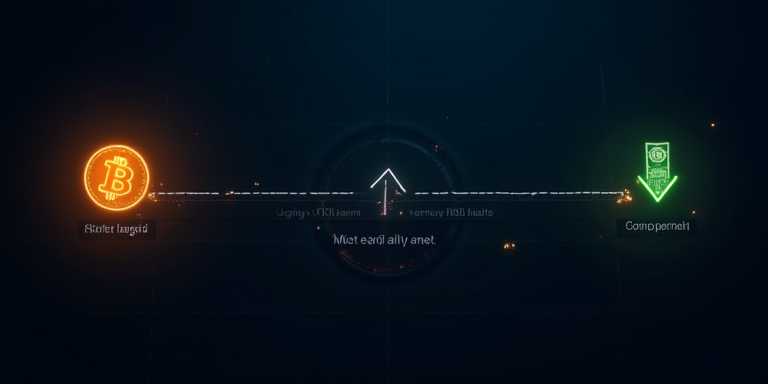
The answer: make long and short pay each other. When the perp trades above spot (over-eager longs), longs pay shorts; when it trades below spot (over-eager shorts), shorts pay longs. That cash flow between sides is the funding rate. The exchange is just plumbing — it doesn’t keep a cut.
(/uploads/20260529/1780061199399-53090.png)

The goal is plain economic incentive: pull the perp price back toward spot. The funding rate is the perp’s anchor; remove it and the contract drifts away from spot.
How the rate is calculated
Formulas differ across venues but share a shape:
Funding rate = interest-rate component + premium index
- The interest-rate component is a small fixed value (often around 0.01%), representing the theoretical borrow cost of the underlying.
- The premium index measures how far the perp is from the spot index — this is the driver of the volatility.
Settlement runs every 8 hours at most exchanges (00:00, 08:00, 16:00 UTC); some venues use 4-hour or 1-hour cadence. At settlement, your notional position value times the funding rate is the amount you pay or receive.
Example: BTC at 60000, long 0.1 BTC (notional 6000 USD), funding rate +0.01%. You pay 6000 × 0.01% = 0.60 USD. Sounds small, until you stack leverage and time — at 10x with three settlements per day, that’s 0.18% off your real margin daily, more than 65% a year. That is why long-only single-direction positions in perps are slow suicide.
Who pays whom: reading sentiment
The sign of the funding rate is itself a sentiment readout.
- Positive funding (longs pay): long-side crowded, perp pushed above spot, longs have to pay to “pull it down.”
- Negative funding (shorts pay): short-side crowded, perp dumped below spot, shorts pay to “lift it up.”
The higher the positive rate, the more crowded the longs; the deeper the negative rate, the more crowded the shorts. Seasoned traders treat extreme funding as a contrarian sentiment gauge — multiple days of +0.05% or more usually means the market is over-optimistic and risk of a flush is building.
That said, this is one input among many. Funding tells you “which side is more crowded,” not “which way the next move goes.” Crowded books can stay crowded until everyone finally cracks — long squeezes and short squeezes are routine in crypto.
Extreme-regime signals
In calm tape, funding wobbles around ±0.01% and tells you nothing. In extreme tape it amplifies.
- Pre-blowoff premium: funding holding +0.1% to +0.3% for 24–48 hours almost always precedes a liquidation cascade. Chasing longs here is grabbing the last torch.
- Post-crash negative print: after a panic flush, funding can snap to -0.1% or -0.5%, meaning shorts are stacked at the brink. The odds of a bounce rise, though it’s never a guarantee — the payoff has shifted, not the certainty.
- Black swan moments: the March 2020 “312” crash, the 2022 LUNA collapse — funding hit extreme readings around both, and in hindsight those were clean top and bottom signals.
Overlay funding onto a candle chart and you have one more dimension beyond pure technicals. The crypto quant primer revisits this: short the high-funding names and long the low-funding ones is a textbook statistical arbitrage.
(/uploads/20260529/1780061234105-99855.png)
How arbitrageurs harvest funding
The classic funding play is the spot–perp hedge, known as Cash-and-Carry: buy 1 BTC spot, short 1 BTC perp (matching notional), price moves wash out across the two legs, and when funding is positive the short leg keeps collecting.
The portfolio is delta-neutral, the only live exposure is the funding cash flow. In bull markets with sustained positive funding, this strategy can run at 10–30% APY and is agnostic to price direction. It’s a favorite of market makers, hedge funds and dedicated arb desks.
For retail to run it, watch the obvious traps: two-sided fees, withdrawal delays, the perp leg getting liquidated and leaving the spot exposed. If the gap between spot and perps still feels conceptual, walk through spot vs futures before structuring the hedge, and use the order-type rules to minimize slippage on each leg.
Funding rate is the live thermometer of sentiment
Back to the opening line — position unchanged, account in flux. Funding compresses long-short sentiment into a number that refreshes every eight hours; it is both the hidden invoice attached to your trade and the live thermometer of market temperature. Step one for beginners: keep a funding strip pinned next to the candle chart before any perp order. Step two for the advanced player: turn the funding stream itself into a tradable cash flow. Not investment advice.