What Are Session Keys, and What Do They Mean for Ordinary Users?
The worst onchain UX pain is not gas, it is signature fatigue. You open a chain game wanting to fight ten monsters, then every single hit triggers a wallet popup — confirm, sign, wait for inclusion. Three or four times in and you close the game. Web2 gamers on Steam never get interrupted like this, they log in once and play for hours. Session Keys bring that “logged-in state” onchain. In 2024 the topic was still research; in 2025 EIP-7702 in Pectra moved it toward consumers; by 2026 it is standard across almost every new chain game, subscription product, and automated trading tool. Let us walk from theory to real examples.
One-sentence definition
A Session Key is a temporary, permission-scoped key authorized by your main wallet for a bounded period, able to sign within defined limits (specific dapp, specific contracts, max amount), and automatically expiring afterward.
Analogy: your main wallet is the master house key, a Session Key is the one-time key you give the cleaner — opens only specific doors, only valid during a window, revocable anytime. In Web2 the concept is called API Token or OAuth Scope. Onchain it did not exist until Session Keys.
The pain without Session Keys
Real scenarios make the problem visible:
Scenario 1: chain game combat. An onchain RPG where every attack, skill cast, and loot pickup is an onchain transaction. Without Session Keys the player taps a wallet popup for each swing — 50 popups in 10 minutes. Drop-off exceeds 90%.
Scenario 2: subscription. An onchain music service charges 5 USDC per month. Without Session Keys the user has to actively sign the charge every month, which turns “auto-renew” into “manual renew” and breaks the subscription model.
Scenario 3: auto DCA. You want to buy 100 USDC of BTC weekly. Without Session Keys you either sign every week manually or hand the private key to a centralized service (huge security risk).
Scenario 4: auto arbitrage bot. High-frequency arb strategies fire dozens of transactions per second. Impossible to sign manually from the main wallet.
These four scenarios share one root cause — the EOA signing model is “one action one authorization”, with no concept of “authorize a class of actions for a bounded scope and time”. Session Keys fill exactly that gap.
Technical principle
Session Keys are not a single technology, they rest on two foundations:
Foundation 1: smart accounts. Only contract accounts can encode “what signature is allowed” logic. EOAs are protocol-hardcoded to accept only the master private key, leaving no room for conditional signing. ERC-4337 smart accounts and EIP-7702-delegated EOAs both meet this requirement.
Foundation 2: modular contracts. A “Session Manager” module is embedded in the smart account contract. It manages a set of temporary keys and their policy bundles. Each Session Key carries:
- Validity window (start, end)
- Contract allow-list (only the game’s GameRouter)
- Method allow-list (only attack(), useSkill(), pickup())
- Amount cap (per-tx max 10 USDC, total cap 100 USDC)
- Frequency cap (max 5 tx per second)
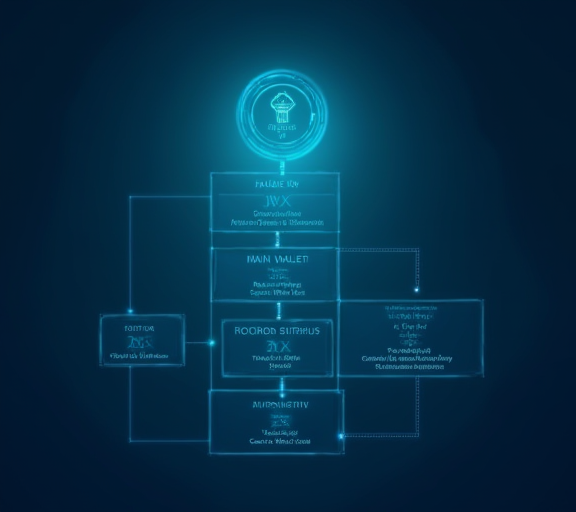
When a Session-Key-signed transaction reaches the smart account, the contract checks validity, then contract, method, amount, frequency — any failure reverts.
Technically Session Keys usually use ECDSA secp256k1. Generation needs no special tooling, the browser or app generates a local keypair. The private key can live in IndexedDB, Keychain, or even dapp memory — because contract enforcement limits the blast radius, leakage damage is bounded.
What EIP-7702 gave Session Keys
Before EIP-7702, Session Keys only worked on native smart accounts (ERC-4337 wallets). The problem: about 90% of users hold MetaMask-style EOAs, and to use Session Keys they had to migrate addresses — which most refuse to do.
EIP-7702 fixed exactly this. Activated in the Pectra upgrade, it lets an EOA temporarily “delegate” to contract code that can include a Session Manager module. Delegation is reversible at any time.
Flow:
- You open a chain game and click “Start Session”
- The wallet asks for an EIP-7702 signature delegating your EOA to a standard Session Wallet contract
- The contract contains the Session Manager module
- The game dapp generates a Session Key and asks you to authorize “for 2 hours, on the game contract, max 1 ETH per tx, total cap 5 ETH”
- You sign once, the Session Key is recorded in the contract
- All in-game actions are signed by the Session Key, the main wallet is not disturbed
- After 2 hours the Session Key expires automatically, or you can revoke anytime
EIP-7702 extended this path to all EOA users, which is the fundamental reason Session Keys mass-adopted in 2026. Detailed 7702 status is in EIP-7702 status.
Real use cases in 2026
Chain games
Pirate Nation, Skystrife, Cambria and other fully onchain games default to Session Keys in 2026. Players sign once on entry to create a session, then every fight, move, and trade flows without wallet popups. This is the first time onchain games actually compete with Web2 game UX.
Subscriptions and SaaS
Loop Crypto, Superfluid integrated Session Key mode through late 2025. The service registers itself as a scoped contract, and the user authorizes “charge 5 USDC monthly to Loop Crypto contract for 12 months”. This is true onchain auto-renew.
Auto trading and DCA
1inch Fusion, CoW Swap, UniswapX all rolled out Session-based limit orders in 2026. You authorize a 24-hour session to the protocol router and it can fill against your target price during the window without you being online.
AI Agents
One of the hottest 2026 directions. AI Agents that act onchain (monitoring, rebalancing, interacting) need exactly Session Keys — you give the agent a strictly scoped key, it operates freely within the bounds, anything outside auto-fails. Far safer than handing a private key to the agent.
Risks and edges
Session Keys are not magic. Edges users should understand:
First, permission granularity depends on implementation quality. A poorly written Session Manager can let calls through that should be rejected. A Q4 2025 Session Manager had a calldata-decoding bug that let attackers bypass amount caps — favor audited implementations.
Second, Session Key leakage is bounded, not zero. If you authorize a “100 USDC per day” key and it leaks, the attacker can drain 100 USDC per day until you revoke. So periodically reviewing and revoking unused sessions is a required habit.
Third, social engineering risk is subtler. A phishing site can trick you into authorizing a Session Key that looks scoped but is too broad. When signing always inspect the exact policy, not just the amount cap.
Fourth, wallet UI must expose a session overview. Rabby and MetaMask both shipped this panel in 2026, but smaller wallets sometimes still lack it — check before choosing.
Practical advice for ordinary users
If you just want Session Keys to smooth UX, the minimum path in 2026 is:
- Use a wallet that supports EIP-7702 (MetaMask, Rabby, Coinbase Smart Wallet, all major wallets do)
- Open a Session-Key-aware dapp and follow the prompt
- Carefully read the authorization popup: target contract, method, amount cap, validity
- Open the wallet’s “active sessions” list monthly and revoke unused ones
Session Keys are one of the core technologies that genuinely improved onchain UX in 2026 — onchain operation finally stops feeling like every step gets interrupted.