How Does Citrea Mainnet Use BitVM2? How Does the Clementine Bridge Work?
On January 27, 2026, Citrea launched mainnet as “the first BitVM2-based Bitcoin ZK rollup.” By early June, bridge TVL hovers around 8,000 BTC and mainnet has produced blocks steadily for over 130 days. This article explains, from an engineering angle, three things: what BitVM2 actually verifies, what Clementine actually does when BTC moves, and where things can still go wrong.
From the homepage Citrea can look indistinguishable from Stacks or Rootstock. The difference is in the stack: Citrea is a ZK rollup using BitVM2 on-chain challenge verification, a path no EVM L2 has walked before.

Citrea Is a Rollup, Not a Sidechain
In Ethereum terms, “rollup” means execution on L2, periodic state commitments to L1, L1 finality. Bitcoin had nothing of the kind because L1 script lacks expressivity to verify a ZK proof directly.
BitVM (Robin Linus, 2023) introduced a workaround: do not ask L1 to verify the proof; let L1 adjudicate between honest and dishonest parties through a challenge-response game. BitVM2 (2024) streamlined that with fewer rounds and lower implementation cost. Citrea is the first to put BitVM2 in production.
Key parameters:
- Execution: EVM-equivalent (Reth/SP1-derived)
- DA: committed directly to L1 Bitcoin (OP_RETURN)
- Proof system: STARK wrapped to Groth16
- Finality: state root per epoch, finalized after the BitVM2 challenge window
What BitVM2 Actually Verifies
Most write-ups say “BitVM2 verifies the ZK proof in Bitcoin script,” which is misleading. Bitcoin script does not execute a SNARK verifier. Real flow:
- The Citrea operator generates a ZK proof (STARK wrapped to Groth16).
- Operator broadcasts state root, proof and compact commitments to a pre-signed BitVM2 setup on L1.
- The setup is not a single script — it is a pre-committed tree of tapscript leaves covering all possible intermediate values in the Groth16 verification.
- Any watcher detecting a mismatch between a declared intermediate value and the real one broadcasts a disprove transaction, slashing the operator’s bonded BTC.
- If no disprove succeeds within the challenge window (7 days on mainnet), the submission is accepted.
In other words, L1 never verifies the proof directly; L1 provides a game-theoretic environment where cheating costs bonded BTC. The pattern is assert-and-challenge with optimistic acceptance — resembles an Optimistic Rollup fraud proof, but the challenge target is intermediate state in the ZK verifier trace.
Clementine: How BTC Moves In and Out
Clementine is the bridge protocol designed by Citrea and implemented by Chainway Labs, symbiotic with BitVM2. Three roles:
| Role | Job | Bond |
|---|---|---|
| Operator | Handles deposits/withdrawals, co-signs L1 releases | Bonded BTC, above per-tx caps |
| Watcher | Monitors operators, triggers disprove | No bond, needs reliable infra |
| N-of-N Federation | Co-signs once at setup | One-shot participation |
The crucial security assumption is 1-of-N honest: as long as one federation participant honestly deleted their key share at setup, a unilateral operator fraud cannot succeed. Citrea’s mainnet setup had 100+ distinct participants — a real improvement over typical multisig bridges (5-of-9, 8-of-15).
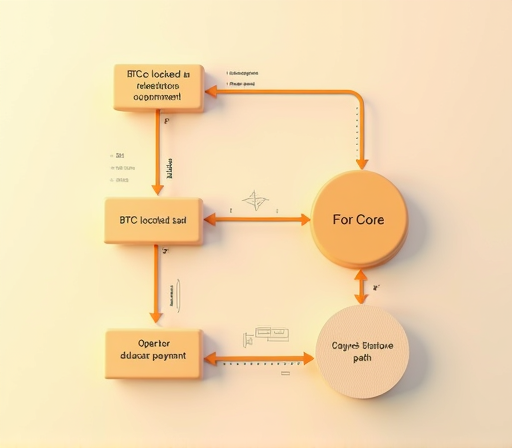
Deposit: User sends BTC to a federation P2TR address → operator mints equivalent cBTC on L2 → BTC stays locked, any release follows BitVM2 setup script paths.
Withdrawal: User burns cBTC on L2 → operator fronts BTC on L1 → operator is reimbursed from federation lock-up via BitVM2 script paths; watchers monitor, trigger disprove if operator over-reimburses, slashing the bond.
How Citrea Compares
I covered Stacks, Rootstock, Botanix and Citrea side by side in Real Bitcoin L2 Use Cases in 2026. Quick:
- vs Stacks: sidechain + PoX, no direct L1 security; Citrea has L1 game-theoretic backstop.
- vs Rootstock: merge-mined sidechain with PowPeg multisig; Citrea uses N-of-N + BitVM2, weaker trust in principle.
- vs Botanix: EVM with spiderchain (BitVM-like ideas + multisig); Citrea’s proofs are smaller, submitted more frequently.
- vs Bitcoin Hyper: see Bitcoin Hyper, an SVM-based Bitcoin L2. SVM execution, different positioning.
Differences cluster around bridge trust assumption and finality guarantees. Citrea pushes bridge trust down to “1-of-N honest at setup,” the lower bound of any published Bitcoin bridge design today.
Four Months In
A snapshot from Citrea explorer and third-party analytics as of early June 2026:
- Bridge TVL: ~8,200 BTC, concentrated in top 20 addresses — mostly institutional / whale.
- Peak daily L2 transactions: ~400,000, predominantly DeFi.
- BitVM2 disprove triggers: 0. Good (no fraud), but means the challenge mechanism has not been stress-tested adversarially.
- Average withdrawal: ~1 hour (fast path) or ~7 days (slow path).
The “never triggered” result is reassuring and a caveat: a theoretically sound system untested under real adversarial pressure has unknown boundary behavior. Optimistic rollups went through the same phase early on.
Practical Notes for Users
- Deposits mint after 6 L1 confirmations, not when your tx hits the mempool.
- Withdrawals split into fast and slow paths. Fast path requires sufficient operator collateral; a wave of withdrawals can exhaust capacity and force the slow path.
- L2 RPC choice affects UX, not settlement.
- cBTC is not BTC. On L2, cBTC is an EVM token. To return to L1 you must withdraw through Clementine — no exchange holds cBTC natively.
This is not meant to discourage usage; it is to help you decide. If you only want BTC yield, Babylon-style native staking is simpler. If you want BTC inside an EVM DeFi environment, Citrea’s bridge currently offers one of the lowest trust assumptions on the market.

What to Watch Over the Next Twelve Months
Zooming out, things worth tracking for Citrea and BitVM2 broadly are not TVL but:
- OP_CAT activation. See Where Does OP_CAT (BIP-347) Stand in 2026. Once OP_CAT is live, BitVM2 setup scripts shrink dramatically and Clementine setup cost and latency drop.
- A second BitVM2 bridge. Clementine is currently the only production-grade BitVM2 bridge. Ecosystem health depends on second and third independent implementations — Bitlayer, BOB, Botanix all have prototypes in flight.
- A real disprove event. The first time a real fraud attempt is challenged and slashed will be the most important live validation BitVM2 receives. Until then, “BitVM2 is proven secure in production” is premature.
Citrea’s position today resembles early Arbitrum and Optimism in 2021: the path has been demonstrated viable, ecosystem builds up steadily, but the true security boundary still needs time and incidents to map out.